
Breast cancer rates remain stubbornly high in Marion County
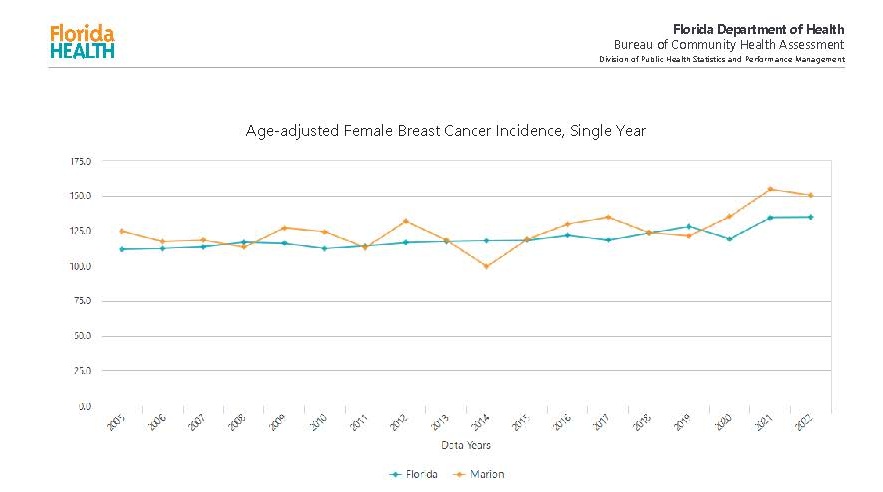
Source: Florida Department of Health
Breast cancer rates in Marion County remain higher than the state average, and local officials and advocates say more residents must commit to regular screenings to reverse the trend.
According to the Florida Department of Health, Marion County recorded a breast cancer incidence rate of about 150.5 cases per 100,000 women in 2022, compared with Florida’s statewide rate of roughly 134.6 per 100,000. The county’s breast cancer death rate was 22.7 per 100,000, above the state rate of 18.1. These numbers place Marion in the state’s highest quartile for both cases and deaths.
At the Oct. 6 commission meeting, Commissioner Michelle Stone, a two-time breast cancer survivor, read a proclamation declaring October “Breast Cancer Awareness Month” and urged residents to act.
“Screening utilization rates for women 40 and older in Marion County are below the Florida average and have declined since 2007 despite increased awareness and access,” Stone said. “Only about half of eligible women get annual mammograms.”
Stone, who discovered her own cancer through self-examination, told the audience that early detection saves lives.
“At 40, all women—well, men, too if you have that history in your family—should get that mammography,” she said. “It’s not as painful as people make it out to be, and it saves lives. The most important thing is, the earlier it’s caught, the longer people get to live.”
Local efforts and barriers
Amy Roberts, LCSW, chair of the Cancer Alliance of Marion County, said there’s no single explanation for the county’s elevated numbers in the 2022 data set.
“Screening rates dropped during 2021–2022 due to COVID-19 shutdowns,” Roberts said in an email to the “Gazette.” “It could be we were finding cancers at later stages post-COVID, influencing some of this data. Other challenges could include under-insured or uninsured populations.”
Roberts emphasized that multiple local organizations are trying to close those gaps.
- Michelle-O-Gram, which funds mammograms for women without insurance, recently deployed a mobile unit in Dunnellon.
- The Department of Health will host a mobile mammogram day Nov. 5 at the Mary Sue Rich Community Center at Reed Place, offering free screenings for eligible women ages 40–64.
- The Estella Byrd Whitman Wellness Center, HUGs Charities, and Langley Health Services also partner to reach Hispanic and low-income residents with education and assistance programs.
Robert Boissoneault Oncology Institute, where Roberts works, sponsors HUGs Charities, which helps cancer patients with living expenses and promotes prevention through community events.
Prevention and personal responsibility
According to the Mayo Clinic, the exact cause of most breast cancers isn’t known. Researchers point to a mix of hormones, lifestyle choices, environmental factors and genetic predisposition.
Roberts said new research suggests that up to 40% of cancer risk is linked to lifestyle.
“We can work as a community to change these statistics by moving more, eating healthy foods, staying away from processed or sugary diets, limiting alcohol, and abstaining from tobacco products,” she said.
Breast cancer begins when changes occur in the DNA of breast tissue cells, causing them to grow and divide uncontrollably. The abnormal cells can form a tumor that invades healthy tissue or spreads elsewhere in the body.
Increased risk factors include age, obesity, alcohol consumption, early menstruation, having no children or children after 30, dense breast tissue, hormone therapy, and inherited mutations such as BRCA1 or BRCA2.
The American Cancer Society notes on its website that “research shows that nearly half of all cancers can be linked to risk factors you can change,” and offers an online ACS CancerRisk360 assessment (cancer.org/cancer/risk-prevention/cancer-risk-360) to learn more about what puts you at risk and what could be changed “to improve your health and lower your cancer risk.”
As the Mayo Clinic notes, breast cancer often results from “a complex interaction of your genetic makeup and the world around you.”
“When cancer is detected early, it is typically linked with better outcomes. Yet only about 50% of those eligible are getting screened,” Roberts said.
Stone urged the community to remind each other to get examined. “Circle a day. Make it a special day every month. Ask your loved one: Have you done your breast self-examination?”

Support community journalism
The first goal of the Ocala Gazette is to deliver trustworthy local journalism so corruption, misinformation and abuse are not hidden from the public or unchallenged.