
Centennial celebration
Osceola Middle School, formerly Ocala High School, has been a key part of the community for 100 years.
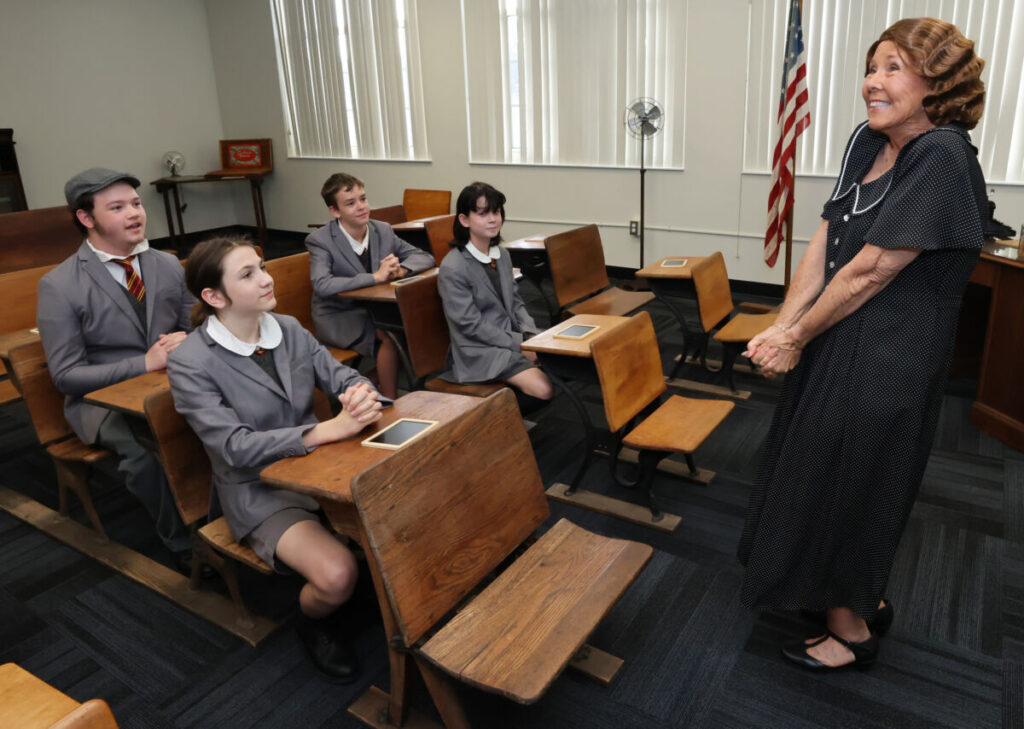
Dee Collier, right, a historical reenactor with Make History Come Alive, portrays Mrs. Collins as she teaches English to her students, from left, Collin Blakley, 15, Leif Bouker, 12, Banjo Bowen, 12, and Josie Hill, 10, in a recreated Model 1920s classroom during the Osceola Middle School Centennial Celebration at Osceola Middle School in Ocala, Fla. on Thursday, Oct. 2, 2025. [Bruce Ackerman/Ocala Gazette] 2025.
Osceola Middle School celebrated its 100th year on Oct. 2. The event saw a large turnout, with current and former staff and students, families, local dignitaries and members of the community in attendance. It was gathering that surely would make the original 1925 staff and students very proud.
The evening was full of activities and old friends reminiscing. Former students spanning several generations mingled and reminisced. There were retired teachers like Elaine Tucci and Marianne Marcoux, who both taught gifted classes at the school, two former Marion County School District superintendents (Jim Yancey and George Tomyn) and longtime former school principal John McCollum. Prominent schools in a community the size of Ocala don’t turn 100 often. When they do, it is a significant event.
Current students took the lead for much of the evening. Osceola Middle School and Forest High School band members joined together to play 1925-style music in the courtyard. Other Osceola students served food from the same era, greeted guests and handed out programs.
One room was converted into an original classroom with antique school desks from the Silver River Museum. Historical interpreter Dee Collier portrayed a teacher from the 1920s and “taught” student actors with help from the Ocala Civic Theatre. Guests could take part in the lessons, and the room saw a steady flow of visitors.
Another classroom became a museum for the evening, with exhibits of school memorabilia. The display was organized by Adam Sines, who volunteers with Mainstreet Ocala, with assistance from the Marion County Museum of History and Archaeology. Old yearbooks, photographs, a 1950s physical education uniform and the original gymnasium scoreboard and clock were just a few of the objects on display. A vintage hand-crank phonograph even played a 1920s record with exercise instructions.
School principal Renee Johnson, who did an outstanding job planning and hosting the celebration, officiated a presentation in the newly renovated auditorium. This included several guest speakers and a special video created by students documenting why the school is special. Matthew Grow, president of the Historic Ocala Preservation Society, also presented a centennial recognition plaque noting the significance of the school.
Comments by Interim Superintendent of Schools Danielle Brewer and Johnson highlighted the history of the school, its strong connection to the community and recent upgrades to the buildings. Renovations include work on the roofing system, HVAC improvements, a new 12,000 square foot cafeteria and a modern gymnasium, which is set to open soon.
Brewer also pointed out that, “Though the physical campus has undergone renovations and new construction through the years, Osceola’s traditions and pursuit of excellence has remained intact.”
A sample of notable alumni included Rose Thomas, a former 45-year educator in Marion County Public Schools and past dean of students at the school. Others include schoolboard chair Lori Conrad, vice chair Rev. Eric Cummings, city of Ocala councilman Jay Musleh and the late Kenneth “Buddy” MacKay, who served as a state representative, senator, lieutenant governor and the 42nd Governor of Florida.
Another theme of the evening was how much life has changed in the last 100 years. While the outward appearance of the main building has changed very little, the facility as a whole has grown over the decades.
Originally, a large front lawn extended east from the front of the main building to Southeast Tuscawilla Avenue. The original gymnasium was added in 1937, and classroom wings were built onto the north and south ends of the main school building in 1951 to accommodate a growing student body. Building 2, which now houses classrooms and the media center, was constructed in 1969 in front of the school (on the original front lawn) and is still in use. A cafeteria building was completed in 2021 and the new gymnasium is nearing completion.
Ocala High School (now Osceola) opened on Oct. 2, 1925. Steeped in history, the words Ocala High School remain carved in marble above the main entrance to this day. In 1956 Ocala High relocated to a new complex and the building became Ocala Junior High School. The name was officially changed again to Osceola Middle School in 1964 when public schools in Florida began the process of integration.
In the South, education and, in fact, society in general, was segregated well into the 1960s. When Osceola opened there were only two secondary schools in town, Ocala High (now Osceola) for white students and Howard Academy for black students. It is worth noting that students were not bused long distances in those days and most rural communities across the county had smaller, often one-room schoolhouses, to serve their students.
In order to appreciate this centennial milestone, it is helpful to consider what life in Ocala was like in 1925. Things have changed dramatically since the school first opened its doors. First of all, for our younger readers, there were no cell phones, computers, home television, internet or air conditioning. The country was in a lull between World Wars, and we were only 25 years past the 1800s.
The 1920s were a time of social and technological changes. Prohibition was in full effect across the United States and popular musicians included Louis Armstrong, Duke Ellington and Bessie Smith. It was illegal to teach about evolution in many states and women had just recently won the right to vote in 1920. Harsh discriminatory Jim Crow laws existed across the South and Ocala was no exception.
In 1925 the creation of the Mount Rushmore monument had just been authorized, the first television image was transmitted in London and President Calvin Coolidge was the first president to have an inauguration broadcast to the nation by radio. Here in Florida, the decade saw a land investment boom and bust, rapid population growth and the arrival of “Tin Can Tourists” with automobiles and early travel trailers (also called tin cans).
One of the most important differences between then and now is the dramatic population increase in Florida. In 1925 there were approximately 6,500 people living in Ocala. Now 71,500 people are estimated to live within city limits and we are still growing. When Osceola opened Ocala was still a relatively small town and many people knew each other.
Although our community has grown significantly, the dedicated staff of our schools help to maintain an environment where traditions matter and people still care. As Marion County continues to change, many things will no doubt evolve. However, the fact that a school like Osceola Middle School just hosted a centennial celebration and that so many community members took part with such fond memories, is reassurance that Ocala and Marion County will remain a great place to live.
Scott Mitchell is the director of the Silver River Museum and Environmental Education Center, which is a program of Marion County Public Schools.



Support community journalism
The first goal of the Ocala Gazette is to deliver trustworthy local journalism so corruption, misinformation and abuse are not hidden from the public or unchallenged.