
Marion County lowers millage rate
The reduction was made possible by a one-time use of COVID-19 relief fund interest.
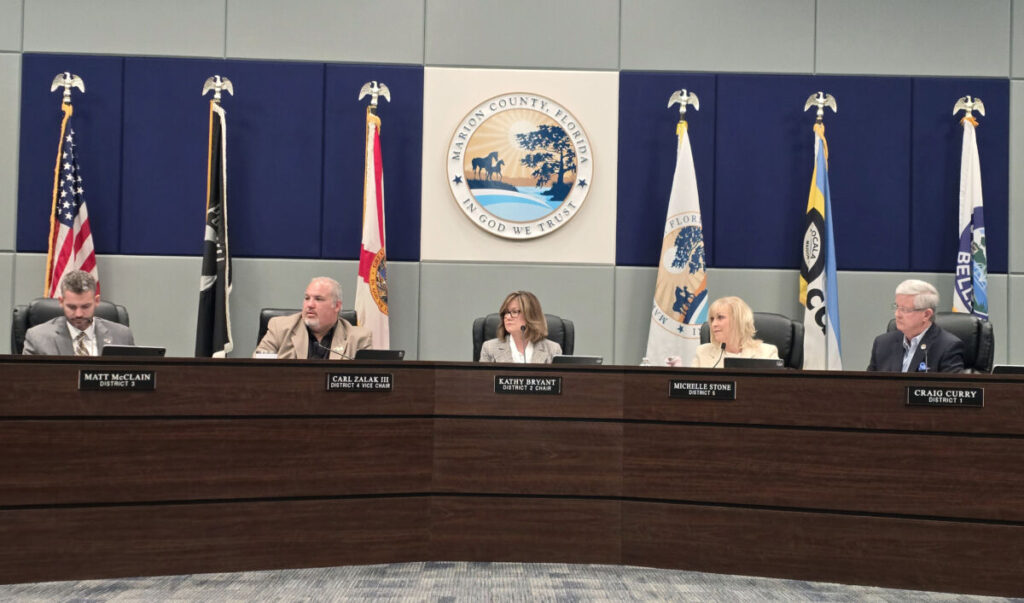
The Marion County Commission meets in the McPherson Governmental Complex in Ocala on Feb. 18, 2025. [Bruce Ackerman/Ocala Gazette file photo]
Marion County commissioners on Sept. 22 adopted a $1.66 billion budget for the 2025-26 fiscal year and cut the countywide millage rate to 4.02 mills, one of the lowest in Florida.
The reduction, from 4.29 mills set during the July budget hearing, means taxpayers will pay $4.02 for every $1,000 of taxable property value for a savings of $2.70 every $1,000 taxable value.
For a home assessed at $300,000 after homestead and other exemptions, that would add up to about $81 in tax savings. Commissioners avoided service cuts by shifting to the general fund $7.8 million in interest earned from federal American Rescue Plan Act (ARPA) funds sent to Marion County as part of then-President Joe Biden’s COVID-19 economic relief plan.
Commissioners previously approved increases in the solid waste assessment from $87 to $215 and fire rescue from $199.91 to $283.97 per dwelling unit while stormwater assessments stayed flat.
Audry Fowler, budget director for Marion County, cautioned commissioners that the reallocation of ARPA interest dollars is a one-time occurrence that could cause hurdles for staff the next budget year to maintain the rate.
Commission Chair Kathy Bryant discounted that concern and indicated that commissioners should have latitude on budget matters.
“This board should be able to lower or raise millage rate as needed when they can make that argument and it is clear and concise to the citizens of this community,” she said. “And I think by taking this money and showing the citizens that when we do have that type of money, we will lower their millage, when we come to them and say, ‘OK, we did that this year. But come next year, we know that we’re going to have to raise it a bit.’ I think it makes the relationship between the government and the citizens much stronger, and it makes them have a lot more trust for us when they see what we do with money, when we have it and it’s not assigned to something specifically.”
Not all commissioners supported using the funds to lower the rate. Commissioner Craig Curry said he preferred to apply the $7.8 million to capital projects.
“I think we need to take the money and look at the capital projects,” he said. “We’ve had a tremendous need in parks and recreation, take that lump sum money and put it somewhere that’s going to be impactful. I mean, doing what you’re talking about doing is watering it down.”
Commissioner Michelle Stone also felt like the money would be better applied to capital projects.
“The citizens of this county expect us to make good, strong decisions on behalf of our community,” she said. “I believe that we’ve had a lot of budget discussions, and there’s a lot of need, there’s a lot of capital needs, the Parks and Recreation, most especially. How many times have we had conversations about that, received emails, how our parks are failing with what we have today, and we don’t have the dollars set aside for it? And we were looking for funding to actually help improve that. This is that opportunity to use those dollars wisely because we’re not going to get the opportunity again. To give somebody a $40 to $60 tax relief is not as beneficial as moving forward the unfunded capital projects that we know we need.”
Bryant pushed back against that notion arguing that to some property owners that was not a lot of money.
Ultimately, the board majority opted to reduce the millage rate for the new fiscal year, which begins Oct. 1. The countywide budget totals $1.125 billion, with another $534 million in non-countywide taxing districts, including fire services, law enforcement and neighborhood taxing units called MSTUs. Those millage rates remained unchanged, including the Fire Rescue MSTU at 1.11 mills.
Commissioners highlighted that the lower millage rate puts Marion County in the state’s lowest 10 for property tax rates. But County Clerk of Court Gregory Harrell underscored the potential risks of using one-time funds for recurring expenses.
“You have to be careful about using one-time revenues to fund ongoing operational expenses because that creates structural imbalance in the budget,” he said.

Support community journalism
The first goal of the Ocala Gazette is to deliver trustworthy local journalism so corruption, misinformation and abuse are not hidden from the public or unchallenged.