
Innovative ideas
Ocala seeks to leverage the Live Local Act and other initiatives to address homelessness.
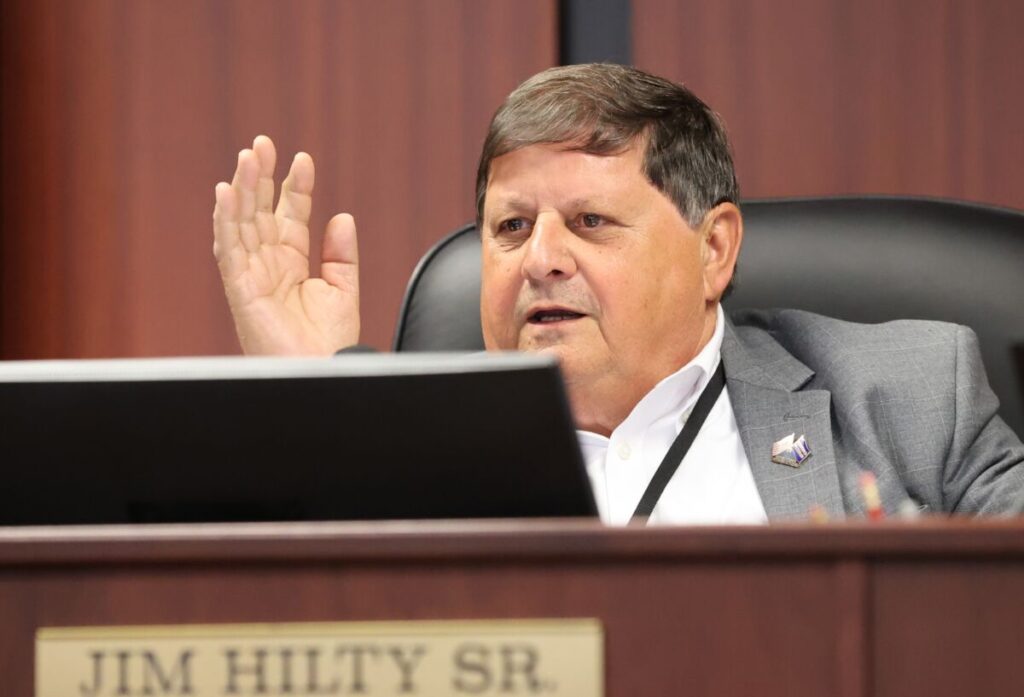
Councilman Jim Hilty is shown during an Ocala City Council meeting in 2022. [Bruce Ackerman/Ocala Gazette file photo]
The city of Ocala is addressing homelessness through innovative solutions, led by council member Jim Hilty, who is championing Florida’s Live Local Act and exploring community-driven efforts aimed at expanding affordable housing for the city’s workforce and vulnerable populations, including those experiencing homelessness.
One such model is Settled’s Sacred Settlements, a Minnesota-based nonprofit initiative that Hilty encountered during a visit to a church in the northern state. According to its website, Sacred Settlements are tiny home communities on church-owned land, designed to combat chronic homelessness by providing permanent housing and fostering supportive relationships through a unique “full community” model.
In Ocala, homelessness remains an issue affecting both veterans and the broader community, with organizations like Veterans Helping Veterans USA advocating for a unified countywide approach to address the crisis.
Signed into law by Gov. Ron DeSantis in March 2023, the Live Local Act represents Florida’s largest investment in affordable housing. It allocated $711 million to programs like the State Apartment Incentive Loan (SAIL) and the State Housing Initiatives Partnership (SHIP). The Act incentivizes developers to build affordable housing by offering zoning flexibility, streamlined approvals and tax benefits.
The initiative allows local governments to authorize multifamily and mixed-use residential developments in commercial, industrial or mixed-use zones, such as vacated shopping centers, if at least 40% of the residential units in a proposed multifamily development will, for a period of at least 30 years, be affordable to individuals making up to 120% of the local area median income.
Developers benefit from exemptions on certain zoning restrictions, smaller lot line allowances and property tax exemptions of up to 75% or 100% for qualifying projects. The Act also provides funding through SAIL and SHIP loans, with an estimated $150 million allocated to encourage affordable housing development. Recent amendments, effective in July, expanded zoning flexibility and definitions to make the initiative more attractive to developers, addressing initial challenges in the Act’s adoption.
“The purpose is to encourage developers with new avenues to develop affordable housing, not Section 8, but workforce housing,” Hilty explained, noting the Act allows for creative land use, such as converting underutilized commercial properties.
Despite these incentives, Hilty acknowledged that developer interest in Ocala has been slow, partly due to a strong economy reducing the perceived need for affordable housing projects.
“The Live Local Act, even though it was put into law, hasn’t really been grasped yet because I think it didn’t have enough teeth for people. And, the economy was running really strong, so the developers didn’t really care so much about that,” Hilty said.
David Tillman, founder and CEO of Tillman & Associates Engineering, LLC, highlighted a key challenge in Ocala’s context.
“The thing is that I think they were headed in the right direction, and they had the right thought process with the language that they were working on with the Live Local Act. But I don’t think that they have accomplished a whole lot with it. There’s not a lot of properties here that have those zoning categories on them that are necessarily well suited for housing developments,” Tillman said.
“It didn’t really open anything up where everybody said, ‘Oh, wait, this is wonderful. I’ve got this piece of property, it’s ready to go for this,’” he continued.

David Tillman [MAVEN Photo + Film file photo]
“I think that there’s more work to do when it comes to the Live Local Act and making some changes and some incentives that the state didn’t necessarily consider,” Tillman said.
Pointing to rising costs of labor and materials, he emphasized that supply and demand needs must be met for housing prices to come down.
“We need to make it a buyer’s market if we want to see prices come down. Think of the rise in prices that we’ve had over the past four years. They’ve been pretty extreme and so that’s because of a lack of supply. So, let’s work on the equation. It’s a simple equation and we just have to keep focusing on it,” he said.
Tillman pointed to one effort Ocala has made in creating affordable homes through a partnership with Scott Siemans, a local developer.
“One of the things to look at is, you’ve got Scott Siemens right now that’s doing an affordable housing project in the city limits. The city partnered with him on it and so he’s dedicated 20% of those homes to be in the affordable category,” Tillman said.
Tillman pointed out a challenge to this effort in how the city’s recent imposition of three impact fees has added $10,000 to the price of each home, a cost ultimately passed on to buyers, which undermines affordability efforts.
“There was a lot of environmental remediation that had to occur that went into the cost of the land. But the city made that partnership deal and that’s what our local governments have got to look to do. The city is the only one that has really reached out and done that. The city’s done a wonderful job,” Tillman said.
Developers, he noted, are not jumping in on the Live Local Act because it does not make sense for Ocala.
“I feel like the pieces of property that are slated for industrial or residential are going to get used for industrial or residential and it doesn’t make sense to put the housing on them. That’s primarily what that Live Local Act did, was it allowed for that. A lot of our industrial property is up on (State Road) 326, in that corridor, and it’s kind of in between 326 and the Farmland Preservation Area. And that’s not really an area that I see anybody building any housing right now. There’s not a lot going on there. It’s south of that that you see the housing and so it’s just something that we don’t have a lot of that land necessarily available for use for housing,” Tillman said.
Hilty said he recently approached Ocala City Manager Pete Lee to explore requiring new multifamily developments to allocate at least 10% of units to affordable housing.
“We used to do that years ago. We need to go back to it,” Hilty said, emphasizing the need to integrate such requirements into city and county regulations, potentially leveraging Live Local Act funding to compensate developers.
The Live Local Act’s recent amendments also enable churches to develop affordable housing on their properties, such as excess parking lots, without navigating restrictive zoning changes. This provision aligns with models like Settled’s Sacred Settlements.
“I was up in Minnesota and visited a church that had about six or seven tiny houses on their property and it was under a thing called settled.org, which is a nationwide company that tries to promote things with churches,” Hilty said.
“And the idea behind the tiny houses was you were able to put them on your property, your parking lot, and the people would live in them. They would get the services from the church, for example, meals and things of that nature. But they will also get guidance from their parishioners and try to get their life back together,” he said.
“That’s just a small example of something that could happen. It has happened in other states, but now with this Live Local Act, if a church again decided they wanted to do something like that, they would be allowed to do that under the new provisions of the 2025 act,” he continued.
Settled’s “full community” approach creates intentional tiny home villages on church-owned land, providing permanent housing and community support for chronically homeless individuals. Approximately one-third of residents are “intentional neighbors,” which means they are volunteers from stable backgrounds who live alongside formerly homeless residents, fostering community through shared meals and activities. “Supportive friends” provide mentorship, helping residents access medical, mental health and career services to rebuild their lives.
Hilty sees potential for Ocala’s faith communities to adopt this model.
“If a church like Queen of Peace, for example, wanted to build affordable housing on their extra property, they could now do that under the Live Local Act,” he said.
The Act’s zoning flexibility empowers churches to develop housing solutions, such as tiny home villages inspired by Settled, without the bureaucratic hurdles of rezoning. This approach complements the Act’s broader goals by offering cost-effective, community-driven housing for those experiencing homelessness.
Beyond the Live Local Act, Hilty is exploring other innovative ideas to address housing needs in Marion County. Inspired by a recent veterans’ meeting, he proposed a “Veterans Village” in collaboration with organizations such as Habitat for Humanity and local veterans’ groups.
“My thought was, why can’t we get the veterans’ groups, one from the Army, one Navy, so on and so forth, to build a small veteran’s village,” Hilty said.
“If we can get the property donated between the city and the county, that, of course, is one of the biggest costs. And then with the labor, we just challenge the branch of services to build their own affordable house for somebody,” he continued.
While these initiatives show promise, challenges remain. Integrating affordable housing requirements into new developments requires changes to city and county regulations, which Hilty is actively discussing with city officials.
The slow adoption of the Live Local Act underscores the need to make incentives more compelling for developers. Hilty remains optimistic, however, viewing the combination of policy-driven solutions like the Live Local Act and grassroots efforts like Sacred Settlements as a powerful strategy.
“There’s lots of ideas floating around,” he said. “We’ve got to get developers to care.”
For more information on the Live Local Act, visit floridahousing.org/live-local-act
To learn about Settled’s Sacred Settlements, visit settled.org

Support community journalism
The first goal of the Ocala Gazette is to deliver trustworthy local journalism so corruption, misinformation and abuse are not hidden from the public or unchallenged.