
A fresh start back to school
The school year starts on a positive note but with some of the same old logistical concerns.
It was a Herculean effort by Marion County’s largest employer, now numbering 6,700 of both part-time and full-time workers, to get more than 46,000 kids back to school on Monday after the summer hiatus.
According to Marion County Public Schools, roughly 88% of the anticipated number of student started the first day, with 259 more than last year’s opening day.
The first day of kindergarten took a staggered start approach with six students a day joining the class for the first three days. Therefore, Aug. 14 is the first full day for all kindergarten students.
In addition to the usual struggles, the district added to two new elementary schools to the mix in Marion Oaks and Winding Oaks, which were still being readied for students up to the last minute. The Sunday before, Interim School Superintendent Dr. Danielle Brewer praised her IT team for working in overdrive to get the technology and necessary connections in the new schools done in time.
The new schools were designed with longer car lines that kept traffic from backing up on the public roads, a dangerous situation that is regularly seen at some of the older schools when the number of parents dropping off and picking up wasn’t as high.
There were other struggles that popped up that reflect that the City of Ocala and Marion County officials play an important role in safety around school campuses.
In an interoffice memo, Director of Safe Schools Dennis McFatten wrote, “Across the district, we received multiple reports of flashing school zone lights not functioning properly. When this occurs, Jeanna Pirkl quickly reaches out to our contacts within the City or County to request necessary repairs or adjustments. Unfortunately, county-maintained lights require a technician to physically respond to make changes, whereas city-maintained systems can often be adjusted remotely.”
“District-wide, every school has some form of traffic control devices in place, ranging from basic signage to flashing speed zone lights and even full traffic signals,” he wrote.
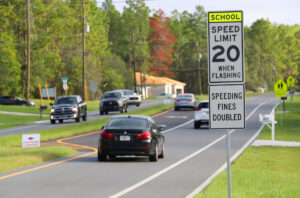
Motorists negotiate the entrance to Ross Prairie Elementary School where there are no flashing yellow lights for the 20 mph speed limit in the school zone on the first day of school at the new Ross Prairie Elementary School in Marion Oaks, Fla. on Monday, August 11, 2025. [Bruce Ackerman/Ocala Gazette] 2025.
Board member Allison Campbel highlighted the positive atmosphere on campuses, stating, “I have had the privilege and opportunity to be on, I think, 14 different campuses in the last two days. Lots and lots of great things are happening on our campuses.”
She also noted a lighthearted transportation mishap.
“One of the fun things that I had an elementary school principal tell me today is that they did have a bus mishap yesterday because two children traded arm bands because one liked the color the other one had,” she said. “It is what it is.”
Board member Sarah James emphasized the importance of support staff and the improvements made to school facilities on the north side of the county.
Board member Eric Cummings addressed the creativity and dedication of district staff.
“We have some terrific, terrific, terrific staff that are creative, that are innovative in how they are setting up their classrooms, what they’re offering to these students,” he said. “I don’t think I saw any two classrooms that were just alike, and so that tells me they’re trying to meet the needs of the diverse group of students who are different, who are ready to learn, but you have to meet the kids where they are.”
Board member Nancy Thrower highlighted the positive effects of the district’s new policy banning cell phones in schools. Thanking state legislators for leading the way, Thrower said the measure allowed “kids to turn back into children where they actually get to interact with each other again.”
However, transportation issues were a recurring concern.
The district is operating about 250 bus routes daily, transporting approximately 23,000 students and covering 35,763 round-trip miles each day—roughly 64 million miles annually.
“One of the things that I don’t want to see, and I’m going to address it now so that we can start working on the problem now is tardy buses,” Cummings said. “I can understand the bus being 10 minutes late. I understand the bus being 20, but I cannot, I cannot, I will not accept the bus being two hours late. We had that, and we can’t have that.”
Prior to school starting, the district announced the new “My Ride K-12” mobile app, which allows parents to track buses in real time using student ID numbers. The district also set up a transportation hotline.
Thrower addressed the challenges faced by families and the district due to issues with the school bus tracking app at the start of the year. She acknowledged the district’s ongoing efforts to improve transportation technology, referencing the previous rollout of the “Here Comes the Bus” app and the introduction of a new version intended to help parents and students track bus arrivals in real time.
“I was really glad to see that we’re continuing to upgrade our apps,” she said. “It’s made such a difference, you know, with when (former superintendent) Dr. (Diane) Gullett rolled out, ‘Here Comes the Bus,’ and now we have a new version.”
However, Thrower pointed out that the new app was not fully operational for the first day of school, which created difficulties for families trying to navigate transportation logistics.
“I’m not sure you know why it wasn’t ready and trained up and functioning by the first day of school, but that was a missed opportunity,” she said.
Thrower emphasized that while there are often understandable reasons for technical setbacks, the district must strive to avoid preventable problems, especially when it comes to tools that directly impact students and families.
“There’s always reasons why things happen, and they’re understandable, but at the same time, we don’t want to shoot ourselves in our own foot, so to speak,” she said.
She concluded by encouraging a mindset of continuous improvement.
“I think that we all, just to quote a not-so-famous football coach, just keep working hard to get better every day,” she said. “You know, that’s what it’s all about, and acknowledge our challenges and problem solving and keep them moving. Because there’s only 180 days.”
Brewer acknowledged the community’s patience, especially regarding transportation for kindergartners.
“The only complaints I saw and heard about were transportation involved. And so, I just want to encourage everyone to be patient, because on Thursday, all kindergartners will be going to school, and so that is one of our biggest challenges for transportation,” she said.

Support community journalism
The first goal of the Ocala Gazette is to deliver trustworthy local journalism so corruption, misinformation and abuse are not hidden from the public or unchallenged.