
Trial by fire station: when public safety officials and media forget due process
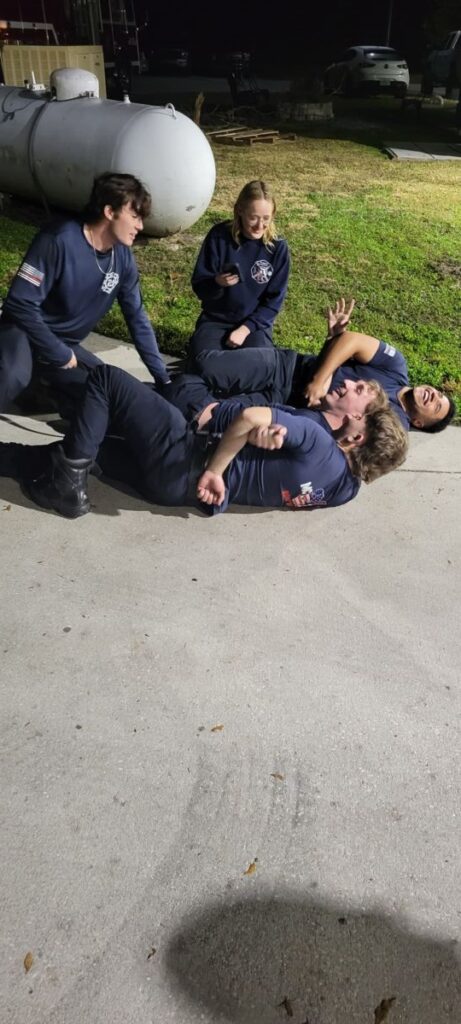
One of the images Judge Timothy McCourt reviewed during a April 30 hearing was taken at 10:14 p.m. Nov. 16 at Marion County Fire Station 21, shows Paramedic Kaylee K. Bradley, 25, holding a cell phone; while Firefighter/EMT Tate Trauthwein, 19; EMT Edward Kenny III, 22; and firefighter/EMT Seth Day, 22, a firefighter/EMT; wrestle with EMT Kayne Stuart,19; in an incident described by authorities as “horseplay that went too far.” [Photo courtesy of Firefighter/Paramedic on scene that day]
|
Getting your Trinity Audio player ready...
|
The recent violent hazing incident involving firefighters at Marion County Fire Rescue Station 21 is more than a local crime story — it is a high-profile example of the breakdown of due process in the court of public opinion.
When public safety officials and the media converge to create a definitive narrative before a case is tried, they risk convicting individuals based on incomplete, and potentially misleading, evidence. The swift condemnation surrounding the hazing events of Nov. 16, fueled by official statements and selectively released images, created a public certainty that the evidence struggles to support.
The story presented to the public was one of clear-cut assault, but a closer look at initial witness accounts reveals a more ambiguous and complicated reality. This review explores the official narrative, including contradictory evidence that was overlooked, and highlights the need for greater responsibility from the institutions charged with protecting public safety and rights.
The official narrative vs. a complicated reality
The four MCFR workers who have been arrested in connection with the incident are paramedic Kaylee K. Bradley, 25, charged with felony robbery and principal/accessory to robbery. Firefighter/EMT Tate Trauthwein, 19; EMT Edward Kenny III, 22; and firefighter/EMT Seth Day, 22, a firefighter/EMT, have all been charged with felony robbery by MCSO.
The arrest affidavit states the victim was working at the station as a “floater” on Nov. 16 to fill a vacancy when a series of minor disputes led to the victim being held down while he was beaten with his own belt and had his cellphone and other belongings taken- then waterboarded.
The incident came to light the day after the victim got off shift, when the victim mentioned to a fellow firefighter assigned to Station 12, Michael Gatto, what had occurred in a telephone conversation around 8 p.m. on Nov. 18. Gatto told detectives that he reported the incident that the victim described through Station 12, not station 21’s chain of command.
Six other MCFR workers, including a station captain and lieutenant who had been recently promoted and the Battalion Chief were also dismissed from employment related to the incident, even though they were not involved in the action.
To understand any complex event, an analyst must first examine the initial perceptions of those who were present, before their memories can be shaped by subsequent investigation and public pressure. The official characterization of the hazing incident, as detailed in administrative investigation documents, was unambiguous. It was described as a “physical assault” that escalated from “inappropriate physical conduct,” resulting in “visible injuries” and “criminal charges.”
This language paints a stark picture of a violent attack.
However, this definitive conclusion is sharply at odds with the initial impressions of multiple firefighters at the scene. Far from a clear-cut assault, witnesses described an atmosphere of chaotic immaturity that they struggled to grasp in the moment.
The commotion, which began over a firefighter’s TikTok account, was perceived by Firefighter Matthew Horton as “normal silliness horseplay.” This assessment was based on the participants’ demeanor, which, most strikingly, included laughter. Horton stated, “They were all kind of laughing and giggling, it was hard to interpret that somebody was in danger.”
His perception was not unique. Firefighter Kaylee Bradley, one of the MCFR workers who has been criminally charged in the case, said in her interview with investigators that at the start of the incident, “I was laughing, too.”
Far from excusing the behavior, these firsthand accounts fundamentally challenge the official narrative of a straightforward criminal assault. An environment of “giggling” and “horseplay” is not the sinister event portrayed to the public. This discrepancy becomes even more glaring when examining the physical evidence provided to support the official narrative.
There is a photograph not being published of the young firefighters (including the alleged victim) laughing and looking at the victim’s cellphone, with a time stamp of 10:12. Why is this photo not being publicly shared? We have asked the county why they did not provide us the photo of the group laughing to us or other media outlets and they have provided no explanation.
Bradley and others admitted that the horseplay went too far on Nov. 16., but also made the claim that the alleged victim, Kayne Stuart, who has now appeared on broadcast news for interviews, had laughed while a coworker was waterboarding another firefighter just the week before.
A trial by photo: Deconstructing the “evidence”
In the digital age, a photograph can be a powerful tool for shaping public opinion, often treated as an objective truth. Yet, without context, a photograph is not a fact but an assertion. A single frame of a complex story can be easily manipulated – especially in this age of AI – to fit a predetermined narrative.
In the Station 21 case, images were presented to the public as incontrovertible proof of a brutal beating. A critical examination of these images, however, reveals plausible alternative explanations that were apparently never considered.
The case of the grease-stained pants
A key piece of “evidence” was a photo of the victim’s grease-stained pants, presented as proof of a struggle on the dirty floor of the fire station bay. Yet, a simple, work-related explanation was available.
In an unsworn statement to detectives, MCFR Lt. Frederick Bowers noted the victim was already “dirty” before the incident began. He explained that earlier in the day, “They had greased the tower,” a routine maintenance task. This account is corroborated by Firefighter Horton, who stated in his interview that after the task, “They all were kind of covered in grease by the end of it.” The grease on the victim’s pants may have been the residue of a firefighter’s normal duties.
This raises the question of why is he still wearing the same grease-stained pants three days after the incident when he gave his statement to authorities and had them photographed? His testimony was that grease was smeared on his shirt, but there is no publicly released photograph supporting that assertion.
“Belt marks” or biology?
Even more troubling were the photographs of the victim’s back, which were publicly identified as marks from being struck with a belt. The images were presented as proof of injury. However, a credible and common biological explanation exists for such markings, particularly in young men.
According to the Mayo Clinic website, markings are visually consistent with striae distensae or stretch marks. One dermatological source, “Biology Insights,” notes that striae are “extremely common, affecting an estimated 40% of adolescent males” during puberty-related growth spurts. Crucially, the source states that in young men, these marks are “most frequently observed on the lower back.”
The rush to label these marks as injuries from a beating, without consulting medical expertise or considering common physiological phenomena, represents a failure of objective investigation. This is more striking considering that when Marion County Sheriff’s Office detectives and fire administrators asked the victim if he had injuries on his back, he replied, “I don’t think so, no, sir.”
When witness accounts are ambiguous and the photographic evidence is open to interpretation, it raises the question how these details would stand up to scrutiny by the department when it decided to fire personnel who were not even in attendance when the incident happened.
This is why the courts have rules about evidence, and we should too
To prevent wrongful convictions based on speculation, manipulated images, hearsay and secondhand accounts, the legal system has developed strict rules of evidence. These rules are not mere technicalities; they are foundational safeguards designed to ensure that judgments are based on the most reliable information available.
The courts rely on rules of evidence to scrutinize the source of information, its complete context and its integrity. The incident that happened at Station 21 reveals just how much was ignored in the court of public opinion.
While the public was shown isolated photos, a court would demand the full context. It would hear testimony from firefighters like Horton, who described the scene as “horseplay.” It would require consideration of alternative explanations for the alleged injuries.
By contrast, the public has seen a curated collection of incriminating images.
Geoff Bichler, Stuart’s workers’ compensation attorney, expressed concern to the “Gazette” that those photos were delivered to the media as evidence of Stuart’s injuries.
Bichler, whose firm specializes in representing first responders for injuries they incur in the line of duty, agreed that, “If a picture is not a true and accurate representation of something that is relevant to the case in terms of injury, then it would be barred from consideration [by the courts].”
The courts would hear sworn testimony from all involved, while MCFR did not take any sworn testimony and relied on ambiguous unsworn statements.
This litany of ambiguity leads to the question of why would leadership at MCFR rush out these conclusions? Particularly if Stuart hesitated to press charges himself?
Had investigators asked the MCFR officials connected to the incident, who have been fired in the aftermath of the incident, if the victim had those marks on his back before the hazing, they might have had concerns about their original conclusions.
We asked our news colleagues at TV station WCJB in Gainesville why they published photos of the victim’s back since it is unusual for journalists to publish photos of a victim’s body without asking for permission.
News Director Jon Levy responded that “these pictures are evidence and will certainly be shown at trial. Four people are facing criminal charges for the allegations he has made regarding the alleged hazing incident. Showing the severity of the allegations is in the public interest considering the public nature of the arrests. Meanwhile, we’ve reached out to the victim on social media (we don’t have his phone number) but have not heard back.”
Of note, the 500-plus employees at MCFR have had access to all of these records, including photos, and it was easy for the rest of the department to know who the name of the victim. Public obtained by the “Gazette” recently indicate that Stuart may be receiving pushback from some colleagues over the way he has handled the incident and its aftermath.
Stuart has been placed on paid administrative leave, and his attorney has put the county a six-month notice of Stuart’s demand for compensation for the losses, injuries and damages sustained by Stuart in the incident.
Conclusion: A call for restraint and reform
The public handling of the Station 21 incident represents a dual failure.
First, it is a failure of MCFR to police its own culture. Second, it is a failure of public officials and media outlets to exercise the restraint required for due process, rushing to judgment with a narrative that ignored contradictory evidence and trampled on the presumption of innocence and ended the career of other first responders who weren’t involved in the alleged assault without due process.
The “Gazette” has criticized the MCSO for similar media tactics in the past; it is alarming to see the MCFR and the Chairman of the Board of County Commissioners, Carl Zalak, take a similar course.
The path forward requires accountability from all parties. MCFR must enact meaningful, transparent reforms to dismantle its toxic culture and failed leadership.
Simultaneously, local officials and media organizations must learn from this episode. All parties must recommit to the principles of evidence-based reporting and presumed innocence, choosing professional diligence over the allure of a sensational story.
Justice is not served by a race to condemn but by a patient and impartial search for the truth, followed by accountability.
Meanwhile, the State Attorney has yet to finalize its charges against the four. One might deduce it is a result of a questionable set of facts and possibly Stuart’s hesitancy to prosecute charges against the four. Stuart did not reach out to law enforcement to report the incident; it was Deputy Chief Robert Graff who insisted the incident be reported to MCSO. In a text message with a friend the day after the incident, Stuart said he just didn’t want to work at that station anymore.
The “Gazette” received an email from a county spokesperson confirming that the county is currently “working on developing a policy to establish an internal affairs investigation process.”
Note: This report will be followed up with a report outlining evidence of cultural struggles within MCFR’s department.

Support community journalism
The first goal of the Ocala Gazette is to deliver trustworthy local journalism so corruption, misinformation and abuse are not hidden from the public or unchallenged.